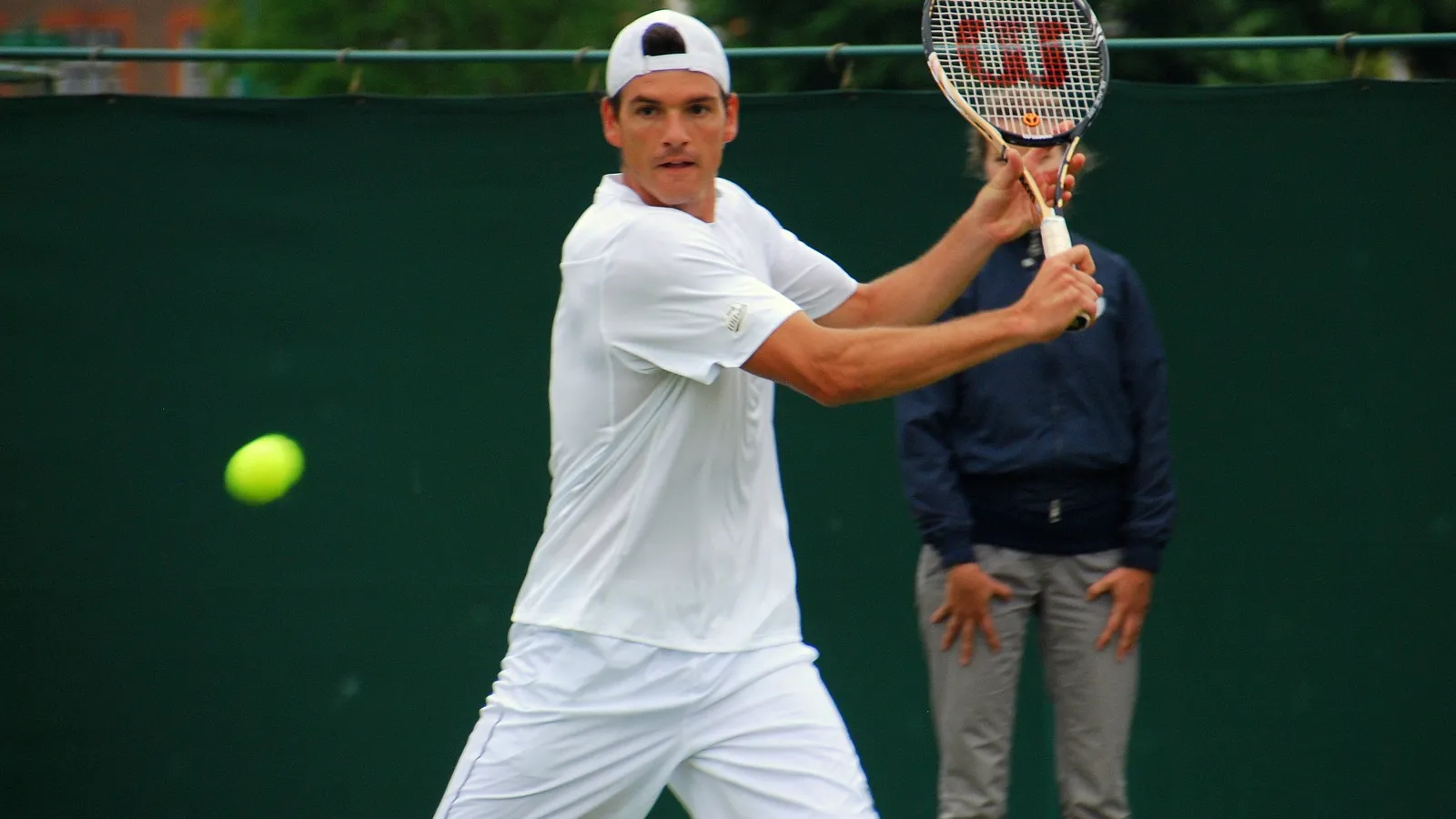
I’m on the shorter side, and the ball that gave my one-hander the most trouble was the high, loopy one that kicked up to my shoulder on the backhand side.
Like a lot of recreational players, my footwork and preparation were mostly not good enough. Opponents noticed, and they started targeting me with high balls.
Most of my backhands ended up high. When I couldn’t do anything with them, I’d reach for an emergency slice, just to neutralise the point or disrupt their rhythm.
I’ve since switched to a two-hander, and high balls are a big reason why. I still love the one-hander, though, and I still hit it now and then. This post is what I’d tell my old self, with help from coaches who know a lot more than I do.
Why high balls hurt a one-hander
A one-handed backhand is happiest with the ball somewhere between knee and waist height, out in front of you. There you can turn, drop the racket below the ball and swing up through it with your legs and shoulders behind the shot.
When the ball is up around your shoulder, most of that goes away. Contact happens about shoulder height, your hitting arm is working above the level where it’s strongest, and there’s no second hand on the racket to steady it. You have less leverage, so it’s hard to hit through the ball. The usual result is a weak reply that floats short, or a mishit into the net.
Two-handers have it easier. Sportplan’s coaching guide to the one-hander lists high balls as one of the arguments for two hands, saying two hands manage shoulder-height balls more easily. Tennisnerd says the same: two-handers can use the off-hand, while one-handers have to retreat, slice or find some other way to get the ball back.
So the high ball will never feel as comfortable on a one-hander as it does on a two-hander. It can stop being a free point for your opponent, though, and there are five main ways to get there.

Norwegian coach Patrik Broddfelt made a whole lesson on this problem. Going by its description, it covers strategies for high-bouncing balls on a one-handed backhand, so it’s a good companion to the options below.
Option 1: move in and take it early
The best way to handle a high ball is to hit it before it gets high. If you move forward and take the ball on the rise, you meet it closer to waist height, before it climbs to its peak. Sportplan’s guide puts this first: spot high balls early and take them on the rise when you can.
This is the aggressive answer, and it comes with a bonus. You take time away from your opponent. Someone who has been happily looping balls to your backhand starts getting them back sooner than they expected.
Federer is the famous example. Tennisnerd’s Jonas Eriksson writes that high balls to the backhand were one of the tools Nadal used to give Federer trouble for years, until Federer started taking the ball earlier with a more aggressive approach. Eriksson adds that a bigger racquet head gave him more margin too.
The catch is that it asks a lot of your preparation, which was exactly the part I was bad at. You need to read the loop early, turn your shoulders as soon as you know it’s coming to your backhand, and move forward with small steps so you arrive balanced. Keep the swing a bit shorter than usual, because the ball reaches you sooner. If you’re late, you end up hitting a rising ball off your back foot, and that’s worse than the high ball you were trying to avoid.
Option 2: step back and let it drop
The opposite answer is to give the ball more time. Take a few steps back behind the baseline and let it come down from its peak to a height you can swing at, ideally around your waist. Sportplan lists this too: move further back to let high balls drop to a comfortable height.
It’s the safer choice, because you get to hit the stroke you’ve actually practised. The cost is court position. You’re now a long way back, your shot has further to travel, and you have more ground to cover if your opponent goes short or wide. A clever opponent will follow a deep loopy ball with a drop shot.
It also depends on the ball. Against a slow moonball, stepping back works well. Against a heavy topspin ball that’s still climbing fast, you can run out of room before it comes down. If you find yourself backing up towards the fence, take that as a sign to try option 1 or 3 instead.
Option 3: the emergency slice
This was the shot I fell back on. When a high ball arrives and you’re not set up to drive it, a slice is often the best shot you have. For me it did two jobs: it neutralised the point, and it disrupted my opponent’s rhythm. Sportplan’s guide agrees that a high backhand slice, while defensive, is safer than a struggling drive.
The slice copes with height better than the drive because its swing starts high anyway. Take the racket back around head height, keep the face slightly open and swing from high to low through the ball. On a high ball you’re cutting down through it, and a one-hander can do that with control.
Aim deep and low. A slice that stays low makes your opponent hit up from below the net, and the change of pace breaks up the rally they were controlling. If they’ve been looping high balls at you all set long, a few low, skidding slices give them a different problem to solve.
The slice I hit on the run shows how it goes wrong. When I got stretched wide, I’d get to the ball and just slice it back, and it was a low-quality shot. A defensive slice still needs a target. When you’re in trouble, send it deep through the middle of the court so they can’t use your angle against you, and use the time to get back into position.


Feel Tennis has a short lesson on using the backhand slice against high balls. It’s the last video in the channel’s series of slice tips, so if your slice needs work in general, the earlier ones are worth a look too.
Option 4: hit the high one-hander anyway
Sometimes you’ll want to drive it, and a topspin backhand from up around the shoulder is a great shot when it comes off. Keep it simple:
- Turn early, so your shoulders are already sideways by the time the ball bounces.
- Take the racket back high, closer to the height of the ball, instead of letting it drop low.
- Make contact out in front of your body, where your arm has room to swing through.
Don’t try to hit it hard. A solid, deep ball at medium pace is a good result off a high backhand.
Option 5: run around it
If the high ball is coming through the middle of the court or a little to your backhand side, and you have time, you can move around it and hit a forehand instead. Sportplan’s guide includes this as an option when it’s possible. It works best when you’re quick to spot the loop, and it leaves your forehand side open, so make the forehand count.
Sometimes two hands is the answer
The high balls kept coming, and my footwork got harder to keep up as I got older and slower. In the end I switched to a two-hander. It feels stable to me, like a reverse golf swing, and it forgives the moments when my feet aren’t where they should be.
If you’re in the same place, that’s fine. Plenty of coaches teach two hands for that kind of stability, and I wrote more about my own switch in I switched to a two-handed backhand, and I still miss the one-hander.
A drill for the high backhand
If you’d like to keep your one-hander, the high ball is the thing to practise. You need a partner and a basket of balls.
- Set up. Stand on your baseline. Your partner stands around their service line and feeds high, loopy balls to your backhand, so they bounce up to around your shoulder.
- Alternate. Slice the first ball deep and low. Drive the second one with an early turn, a high takeback and contact in front. Keep switching.
- Move your feet. After ten balls, spend a round moving in and taking every feed on the rise. Then spend a round stepping back and letting every feed drop.
- Keep score. Count how many land past the service line on your partner’s side. Try to beat it next session.
When it starts to feel easy, ask your partner to mix in the odd short ball, so you have to decide which option to use on each one.